
Hands on Learning Games at Home That Stick
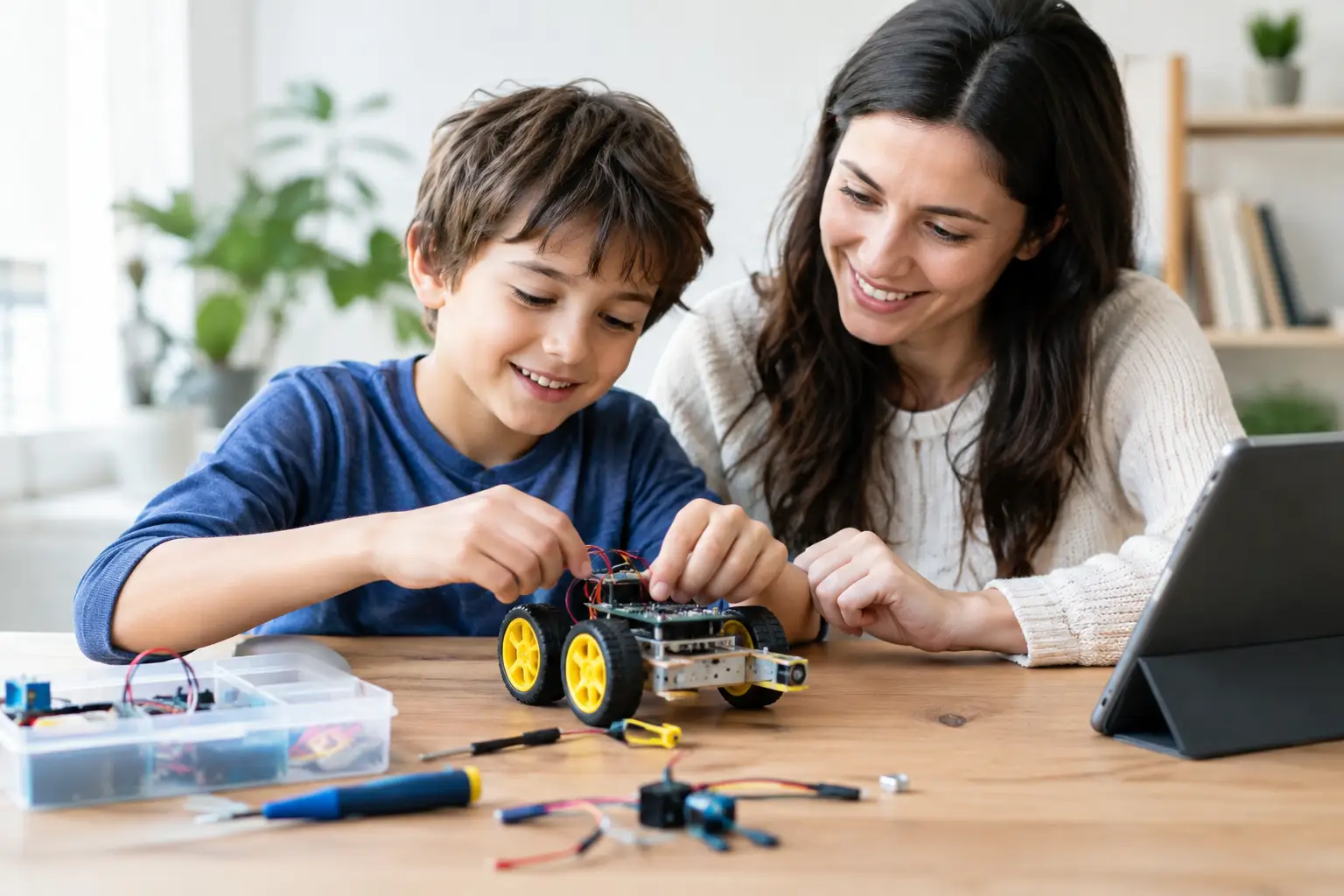
A child is measuring flour for a pretend bakery, negotiating prices with a sibling, and realizing they do not have enough money for every ingredient. They are not waiting for a lesson to begin. The lesson is already happening. Hands on learning games at home give children a reason to pay attention because their choices matter inside the experience.
This is the difference between being told an answer and discovering why the answer works. A good game creates a small real-world adventure: a problem to solve, a role to inhabit, consequences to notice, and another chance to try. Play → act → discover → remember.
Why Hands On Learning Games at Home Work
Learning lasts when the mind has something meaningful to hold onto. A page of facts can be useful, but facts become easier to recall when they are connected to a decision, an emotion, a mistake, or a moment of success. When children handle objects, make predictions, and respond to feedback, they build patterns through participation.
That does not mean every activity needs a visible academic objective. In fact, announcing the lesson too quickly can drain the energy from the game. The goal is not to disguise a worksheet with colorful pieces. The goal is to create a situation that naturally calls for counting, communicating, planning, reading, observing, or reasoning.
Repetition matters here, but not the repetitive kind that feels like compliance. In a game, children return to the same useful skills because they want a better outcome next time. They count again to make a purchase. They read again to find the next clue. They explain their thinking because their team needs a plan. Feedback arrives through the experience itself.
Different children enter learning through different doors. One may want to build. Another may want to tell the story, keep score, negotiate rules, or search for hidden evidence. Hands-on play makes room for those differences while keeping everyone connected to a shared challenge.
Start With a Scenario, Not a Subject
Instead of asking, “How can we practice math?” try asking, “What would a market owner need to do before opening day?” Instead of, “How can we work on reading?” ask, “How can we decode the message that leads to the missing map?” The subject is still there. It simply has a job to do.
A home game needs only three ingredients: a clear mission, a few choices, and feedback. The feedback can be simple. Did the bridge hold the toy car? Did the family stay within its travel budget? Did the investigator find enough evidence to make a fair accusation? When the result is visible, children can adjust without needing a long explanation.
Keep the setup light. A cardboard box, coins, sticky notes, kitchen tools, a timer, old magazines, and ordinary household objects can become the materials for a whole afternoon of discovery. The experience matters more than a perfect set of supplies.
Five Games That Turn Home Into a Learning Space
Run the neighborhood market
Set up a small market with snacks, toys, books, or handmade coupons. Give each player a budget and price the items with whole dollars for younger children or dollars and cents for older players. One person can be the shopkeeper, then switch roles after a few rounds.
Children practice addition, subtraction, comparison, and mental math because the choices have consequences. If a player spends too much early, they may not have enough for something they want later. Add a surprise card such as “Delivery costs increased” or “A customer wants a discount” to bring in flexible thinking.
The game works best when the prices are close enough to require thought but not so difficult that momentum disappears. For a child still building number confidence, use five items and small amounts. For teens, add inventory costs, profit margins, and a limited advertising budget.
Build a rescue route
Create a problem: a toy animal is stranded across a “river,” and the team must build a route using paper, tape, blocks, string, or recycled materials. Decide on constraints before building. Perhaps the rescue vehicle must cross without touching the floor, or the team has only ten minutes and three feet of tape.
This is engineering in its natural form. Children imagine, test, notice what fails, and revise. Resist the urge to solve the problem for them. A bridge that bends or collapses is not wasted effort. It is feedback with a story.
After each attempt, ask one question: “What did you notice?” That small pause helps turn action into understanding. The group may discover that a wider base changes stability, that weight needs support, or that a plan on paper is different from a structure in the room.
Create a clue trail
Write a short chain of clues that leads to a small surprise, a family activity, or simply the next location. Clues can involve rhymes, simple directions, codes, vocabulary, maps, or facts related to a current interest. A clue under the couch might require players to read a sentence carefully. A clue by the refrigerator might ask them to interpret a recipe measurement.
For older players, create an evidence board instead of a straight path. Give them several clues, including one or two that are irrelevant, and ask them to identify what actually supports the case. This adds reasoning and source evaluation without turning the game into a lecture.
Let children design the next trail for someone else. Creating clues requires them to think from another person’s point of view, sequence information, and communicate clearly. The maker is learning as much as the finder.
Plan a mission with a real budget
Give players a mission: plan a picnic for four people, equip a campsite, prepare for a long power outage, or organize a birthday celebration with a fixed amount of play money. Provide a menu, catalog pages, or a simple handwritten price list. Include needs, wants, and a few unexpected events.
The strength of this game is the conversation it creates. Is the cheapest option always the best? What happens if every dollar is spent on one exciting item? Which items solve more than one problem? These are practical questions, and children can feel the trade-offs rather than memorize a definition of budgeting.
Be honest about the limits of the simulation. Real family finances are personal and can be complicated. Keep the game fictional, playful, and age-appropriate. The purpose is to practice decision-making, not to place adult pressure on children.
Become the family museum team
Choose a handful of ordinary objects: a key, an old photo, a ticket stub, a recipe card, a tool, or a souvenir. Players become curators preparing a tiny museum exhibit. They must observe each object, ask questions, write labels, arrange the display, and guide visitors through it.
This game invites history, writing, visual organization, and careful observation. A child might notice dates, materials, wear marks, or clues about who used an object and why. The point is not to guess perfectly. It is to distinguish what they can observe from what they infer.
Invite the child to narrate the exhibit aloud. Speaking from the role of curator gives ideas a shape. It also lets learners who are less comfortable with formal writing show what they understand through explanation and storytelling.
Make Room for Choice and Return Visits
A game does not need to last for hours to matter. Twenty focused minutes can create more learning than a long activity that no one wants to finish. End while curiosity is still present, then leave a way back in: save the market prices, leave the bridge materials out, or add a new clue to tomorrow’s trail.
Choice keeps the experience alive. Offer two possible missions, let children choose roles, or ask what twist should happen next. Adults still provide the structure and emotional safety, but children gain ownership of the path. That ownership is especially valuable for learners who have begun to associate schoolwork with getting it right for someone else.
Notice the moments when a child changes strategy, explains a pattern, asks a sharper question, or tries again after a failed attempt. Those are signs that learning is taking root. You do not need to interrupt the game to label every skill. Let the experience do its work.
The next time the afternoon feels restless, begin with a mission instead of an assignment. Put a problem in the room, offer a few materials, and let your learner step into the story. Live the experience. Keep the knowledge.