
Cooperative Learning Game Reviews That Matter
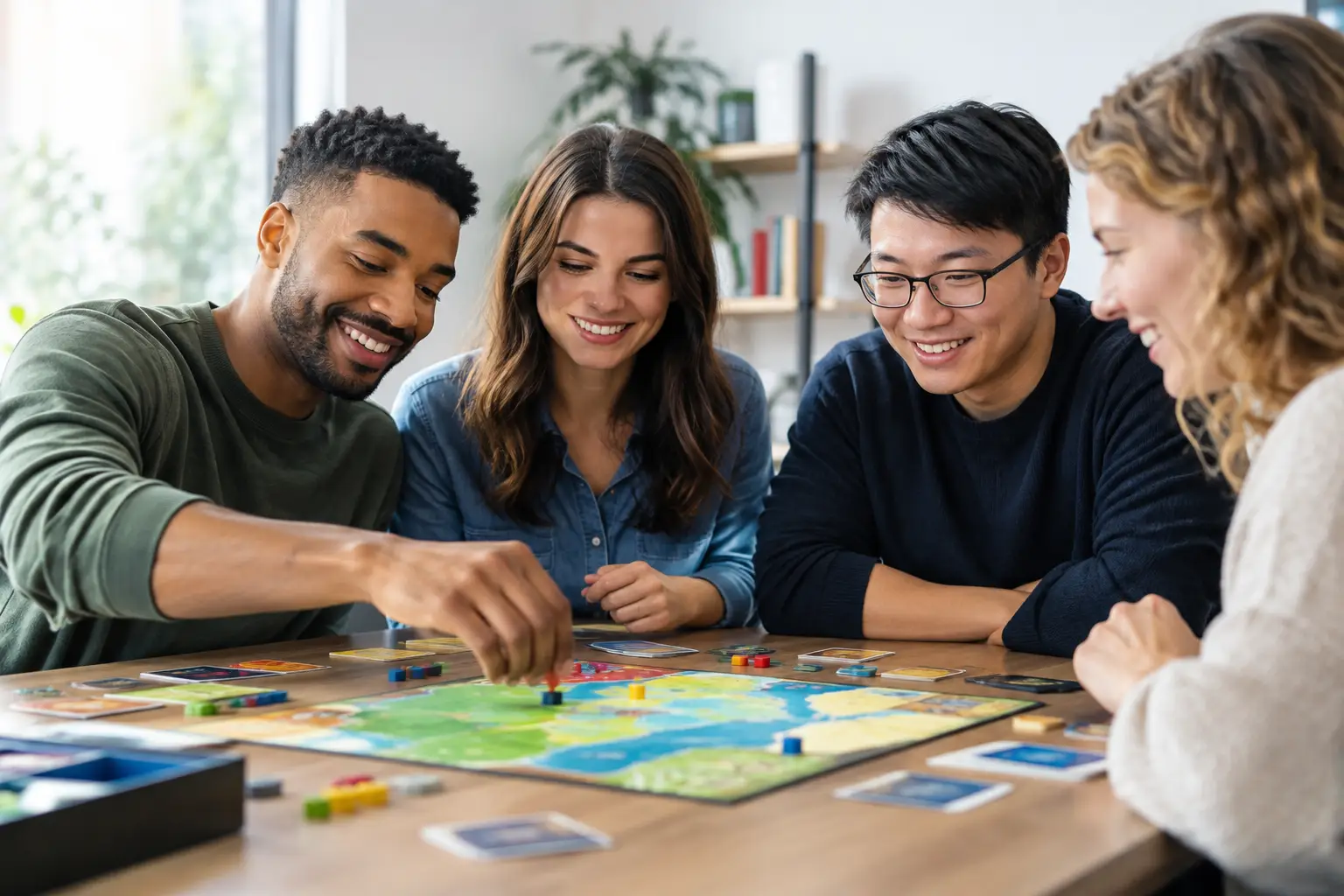
A game can call itself cooperative and still leave one child doing the thinking while everyone else waits for a turn. That is why cooperative learning game reviews need to look beyond whether players share a goal. The better question is whether the experience gives every player a reason to pay attention, make choices, test ideas, and respond to what happens next.
When cooperation is real, learning is not a layer added after the fun. It lives inside the decisions players make together. A clue matters because the team needs it. A mistake matters because it changes the next move. A new strategy sticks because players have lived the consequence.
What cooperative learning should feel like
A meaningful cooperative game creates healthy interdependence. Players can contribute in different ways, but no one is merely watching. One learner may notice a detail, another may organize information, and another may be ready to take the risk. The group succeeds by bringing those strengths into the same unfolding situation.
This matters especially for families and classrooms with different kinds of minds in the room. Some learners talk their way toward an answer. Some need to handle materials, see a pattern, or try a possibility before it makes sense. Some are energized by a clear role; others need freedom to investigate. A strong game makes room for these differences without turning them into labels.
The experience should also have a purpose players can feel. Saving a town, solving a mystery, planning a route, managing limited resources, or making a difficult choice gives information a home. Facts become useful because they help the group move forward. Play, act, discover, remember.
How to read cooperative learning game reviews
Reviews are most useful when they describe what players actually do, not only what is inside the box. Comments about beautiful art, clever components, or a popular theme can be helpful, but they do not tell you whether the game will hold a learner's attention or build understanding.
Look for evidence of player action. Does the reviewer mention discussion, problem-solving, experimentation, negotiation, or changing plans? Do players make choices with visible consequences? These details point to an experience that asks learners to participate rather than simply receive instructions.
Also notice who the reviewer is describing. A game that shines with four highly verbal adults may be frustrating for a mixed-age family. A game that works beautifully in a quiet pair may become slow and scattered with a class of 28. The best review is not a universal verdict. It offers enough context for you to recognize whether the setting, age range, group size, and time available resemble your own.
A review that says, “My students were engaged,” is a promising start, but it needs a little more. What were they engaged in? Were they comparing ideas? Returning to a failed plan? Asking questions after the game ended? Lasting learning leaves traces in the conversation, not only in the noise level.
Signs the cooperation is doing real work
The strongest reviews often reveal a few specific conditions. Read for these patterns:
- Players hold different pieces of useful information, resources, or perspectives.
- A decision made by the group changes what becomes possible next.
- Feedback arrives during play, so the team can adjust rather than wait for an adult to announce the answer.
- The challenge cannot be solved consistently by one confident player taking over.
- Success requires communication, observation, and repeated attempts, not only luck.
No game needs every one of these features in the same amount. A light, fast game may lean on communication and quick feedback. A longer adventure may ask teams to manage resources and revise a plan over several rounds. What matters is that cooperation changes the experience. If each player could make the same moves alone with no loss of meaning, the game may be multiplayer, but it is not deeply cooperative.
Learning value is more than a lesson label
Many educational games advertise a subject: math, science, history, language, or social-emotional learning. That label can help you narrow the search, but it should not make the decision for you. The learning mechanism matters more than the category.
Consider a science-themed game. Does it ask players to use observation and cause-and-effect reasoning? Do they form a hypothesis, act on it, and see a result? Or do they pause play to answer a fact question before moving a token? The first design lets understanding grow through participation. The second may still support recall, but it can feel like a worksheet wearing a game costume.
The same distinction applies to social learning. A game does not build collaboration simply because players are seated at the same table. Collaboration develops when learners practice listening, explaining their reasoning, managing disagreement, and recognizing how another person's insight changes the group’s next step. Those are skills formed through repeated lived moments.
At ImmersiveMinds Games, this is the heart of the approach: real-world adventures where learning is embedded in action, discovery, choices, repetition, and feedback. The player does not stop the adventure to learn. The adventure is where learning happens.
Watch for the takeover problem
Cooperative games have a common trade-off. When the challenge is too open or the rules are too complex, an eager adult, older sibling, or fast-deciding classmate can begin directing everyone else. The group may still win, yet the quieter learners lose the chance to think through the situation themselves.
Thoughtful reviews often mention whether a game prevents this. Some games give each player a private clue, a distinct responsibility, or a turn structure that creates space for every voice. Others work best when an educator sets a simple norm: explain your idea, then let the group decide. Neither approach is automatically better. Private information can create rich communication, while shared information can support younger players who are still learning how to plan together.
Pay attention to comments about frustration as well. A little uncertainty can be valuable. It invites learners to make a prediction, take action, and revise their thinking. But confusion caused by unclear rules is different. Productive challenge says, “What should we try?” Unclear design says, “What are we allowed to do?” Reviews that separate those experiences are worth their weight in gold.
Choose for the moment, not the marketing promise
A cooperative game is not always the right fit. If a class has ten minutes between transitions, a sprawling campaign adventure may create more setup than learning. If siblings are tired after a long day, a game with constant discussion may ask too much. A short, repeatable challenge may be the wiser choice.
Likewise, a game with a strong story can be memorable, but story alone is not enough. Ask whether players influence the story through meaningful decisions. If every session follows the same path regardless of what the team does, the narrative may entertain without giving learners much agency. If choices reshape the next problem, players begin to see themselves as capable decision-makers.
For families, reviews that mention replayability deserve special attention. Repetition is not a failure to move on. In a well-designed game, returning to a familiar challenge lets players notice new patterns, test a better strategy, and build confidence without the pressure of starting from zero. A child who asks to play again may be asking for another chance to understand.
For educators, practical details count too: setup time, reset time, group size, reading demand, and the amount of facilitation required. A beautiful game that needs one adult at every table may not fit a busy classroom. A simpler game with clear feedback and independent group play may create more meaningful learning across the room.
Questions worth asking before you choose
Before trusting a glowing rating or a single disappointing comment, picture the game in your own hands. Who will play? What will each person be doing? Where will the feedback come from? What happens when the team makes a poor choice? And after the game ends, what might players still be talking about?
The most valuable cooperative experiences do not force every learner toward the same answer in the same way. They invite people to notice, contribute, reconsider, and try again. That is how a shared challenge becomes more than a shared activity.
Choose the adventure that gives your learners a reason to lean in, a role in what happens next, and enough room to discover that their choices matter.