
Classroom Games With Immediate Feedback That Lasts
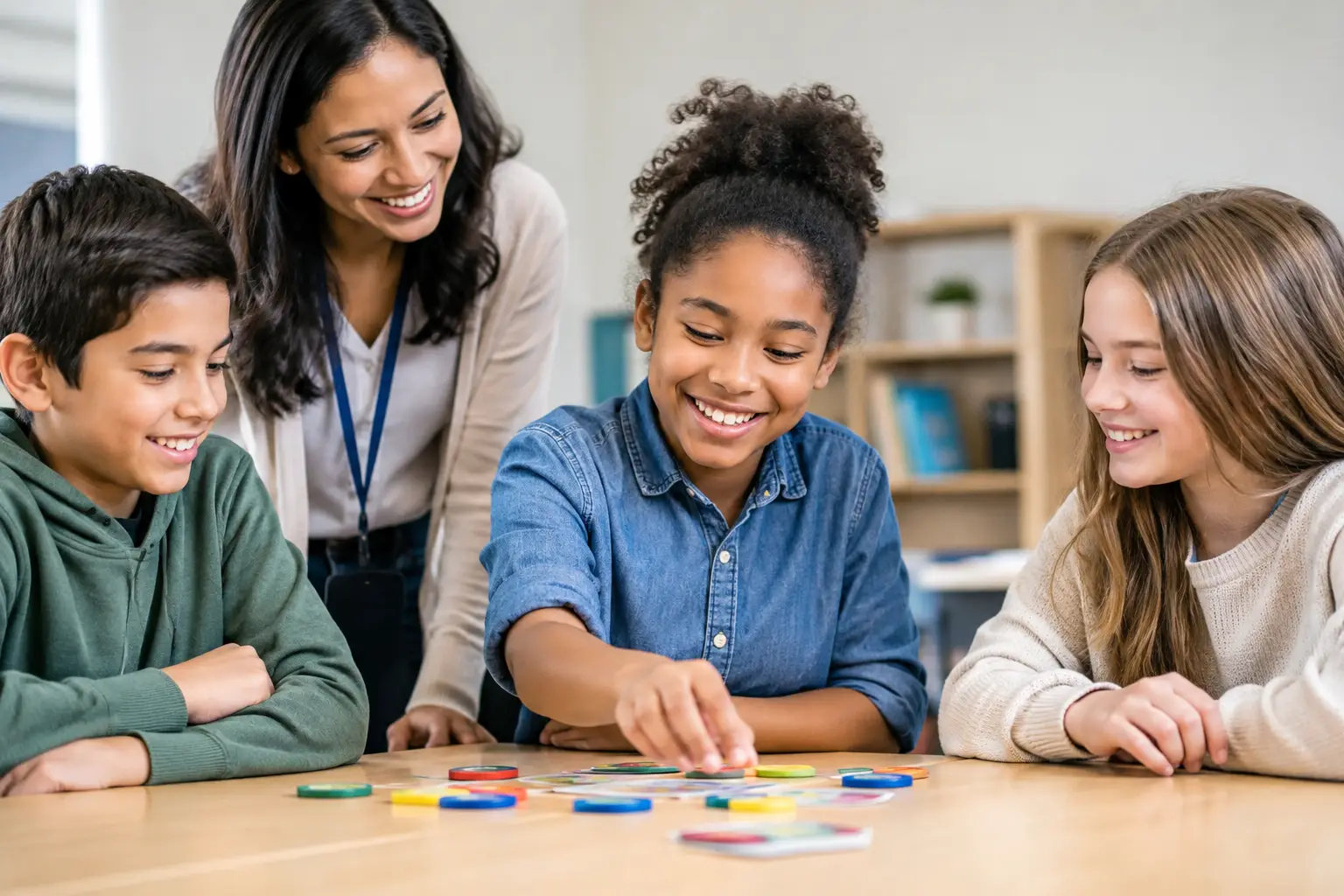
A student chooses a route, tests an idea, makes a trade, or solves a clue. Something happens right away. The choice works, fails, changes the situation, or reveals a new possibility. That is why classroom games with immediate feedback can hold attention so powerfully: learning is no longer postponed until a grade appears days later. It lives inside the moment.
For many learners, this changes the feeling of school. Instead of being asked to memorize an answer before they understand why it matters, they get to act, discover a consequence, and try again. Play becomes a place where knowledge has a job to do.
Play → act → discover → remember.
Why immediate feedback changes the learning experience
Feedback is not simply praise, points, or a red mark beside a wrong answer. In a meaningful game, feedback is information that helps a player see the effect of a decision. A bridge holds or collapses. A budget survives another round or runs out. A team gains a clue because it noticed a pattern. A character trusts the player, refuses to help, or presents a harder problem.
The timing matters. When feedback arrives while a student still remembers the decision they made, the connection is easier to form. They can ask, “What did I miss?” and test a different approach before frustration hardens into disengagement. Repetition then has a purpose. It is not repeating a worksheet item to prove compliance. It is revisiting a choice because the learner wants a better outcome.
This is especially helpful for children and teens who do not thrive through explanation alone. Some learners need to move, negotiate, observe, build, or make a real decision before an abstract concept becomes clear. Others may understand an idea quickly but need a challenge that keeps their attention present. A well-designed game can make room for both.
What good classroom games with immediate feedback look like
The best feedback does not interrupt the experience to announce that learning is happening. It belongs naturally to the world of the game. If players are running a fictional town, their choices affect resources, safety, and community trust. If they are investigating a mystery, evidence either supports a theory or sends them back to look more closely. If they are navigating a historical scenario, alliances and consequences reveal the pressures behind events.
That distinction matters. A trivia question followed by a green check mark is immediate feedback, but it is often thin feedback. It tells a learner whether an answer was accepted. It may not show why the answer matters, how the idea works, or what changes when the answer is wrong.
Richer classroom games create feedback loops with consequence. Players notice a result, interpret it, adjust their next move, and see what happens. Over time, useful patterns become familiar. A student does not only recall that planning ahead is valuable. They have felt the difference between a rushed decision and a prepared one.
Feedback should be clear, not punishing
Fast feedback can become discouraging when every mistake feels public or final. A game built for learning should treat incorrect choices as information, not identity. The message is not, “You are bad at this.” The message is, “That strategy did not work here. What will you try next?”
This does not mean removing challenge. Real learning often includes uncertainty, failed attempts, and revision. The difference is that students have a path back into the experience. They can regroup, gather more evidence, ask a teammate, or make another choice. A safe-to-retry environment supports intellectual courage.
Feedback should point to the decision
Points and timers can add energy, but they should not become the entire game. If students receive a score without understanding what earned it, they may chase the number rather than the insight.
Better feedback connects directly to player action. “The supplies did not last because your group spent too much before the storm.” “This code did not open the lock because the sequence does not match the evidence.” “Your argument changed the outcome because it used the strongest source.” The learner can trace the result back to a choice.
Designing a game moment that teaches
A classroom game does not need a screen, expensive equipment, or a complicated rulebook. A role-play, a card challenge, a physical puzzle, or a collaborative mission can create powerful feedback when the structure is intentional.
Start with one decision students should learn to make more thoughtfully. In science, that might be choosing which variable to test. In math, it might be selecting a strategy rather than guessing an operation. In social studies, it might be weighing competing priorities with limited resources. In language arts, it might be deciding which evidence best supports a claim.
Then make the consequence visible. If a decision has no observable effect, students cannot learn much from it. The effect might be a changed map, a new clue, a shifted score, a response from another team, or access to a new part of the challenge. It should be close enough to the decision that students can connect cause and effect.
Finally, build in another chance. One attempt can reveal a misconception. A second attempt allows the learner to revise it. This is where the game begins to do more than entertain. It creates a cycle of attention, action, feedback, and adjustment.
Four game formats that naturally create feedback loops
Some formats make immediate feedback especially easy to build into a classroom.
- Scenario games ask students to make choices inside a realistic situation. Their decisions change the next problem they face, making trade-offs visible.
- Mystery and investigation games reward careful observation. A wrong theory may lead to a dead end, while overlooked evidence can reopen the case.
- Strategy challenges make planning visible through resources, turns, routes, or limited options. Students quickly see whether a plan can survive changing conditions.
- Collaborative escape-style missions show the value of communication and shared reasoning. A group progresses when ideas are tested, combined, and refined.
The format should fit the learning goal. An energetic timed challenge may be useful for practicing fluent recall, but it may be a poor fit for a topic that needs careful reflection. A complex simulation can build deep understanding, but it can also demand more setup and facilitation. The right game is not always the loudest or fastest one. It is the one that gives students meaningful actions and useful consequences.
The teacher’s role: guide the pattern, not every move
When a game is working, the educator does not need to explain every lesson before play begins. Their role is to frame the mission, protect psychological safety, notice where learners are stuck, and ask questions that help students make sense of what happened.
A short pause can be more valuable than a long debrief. Ask, “What choice changed the game?” “What did your team assume?” or “What would you do differently if you had one more turn?” These questions return students to the pattern beneath the activity.
It also helps to resist rescuing learners too quickly. Productive struggle needs boundaries, but it needs room. If the game provides clear feedback and students have a genuine chance to respond, they can experience the satisfaction of figuring something out for themselves.
Keep the adventure larger than the reward
Badges, leaderboards, and prizes can motivate some students. They can also distract from collaboration, curiosity, and deeper thinking. When the reward becomes more important than the mission, students may optimize for points instead of understanding.
The stronger motivator is often the experience itself: the mystery they want to solve, the community they want to protect, the plan they want to make work, or the story they want to complete. This is the principle behind real-world adventure learning. The game gives knowledge a meaningful place to live.
For parents, educators, and learners, the question is not whether play is serious enough for learning. The better question is whether learners are making decisions that matter, receiving feedback they can use, and getting the chance to try again.
Give students a world worth paying attention to. Let their choices shape what happens next. When feedback arrives inside the experience, the lesson does not have to chase them afterward. They carry it forward.